Getting the right tyres is crucial to the success of your touring trip.
Before getting into the detail, I cannot emphasise enough how much of a massive pain it is to get a puncture when touring. At best, having to unload the bike and sit in the blazing sunshine on the hard-shoulder of a busy road to repair a soggy tyre is not much fun. And if you inadvertently find yourself getting several punctures on a particularly rough stretch of track, not having the right spares can be enough to derail a whole holiday.
What do I use
My tried-and-tested setup for touring tyres is:
- Schwalbe Marathon Plus outers (I use 700 x 32C).
- An old inner tube cut along its length and used to line the outer tyre.
- Slime inner tubes.
- Inflated to between 80-90psi
In the last couple of years I have done 3000 miles on this setup without a single puncture. This includes a lot of grotty continental hard-shoulders covered in broken glass, and long stretches of gravel cycle paths with the really fine, sharp gravel that often works its way into the rubber of cheaper tyres.
This setup was recommended to me by the touring experts at Spa Cycles, Harrogate.
What’s the logic?
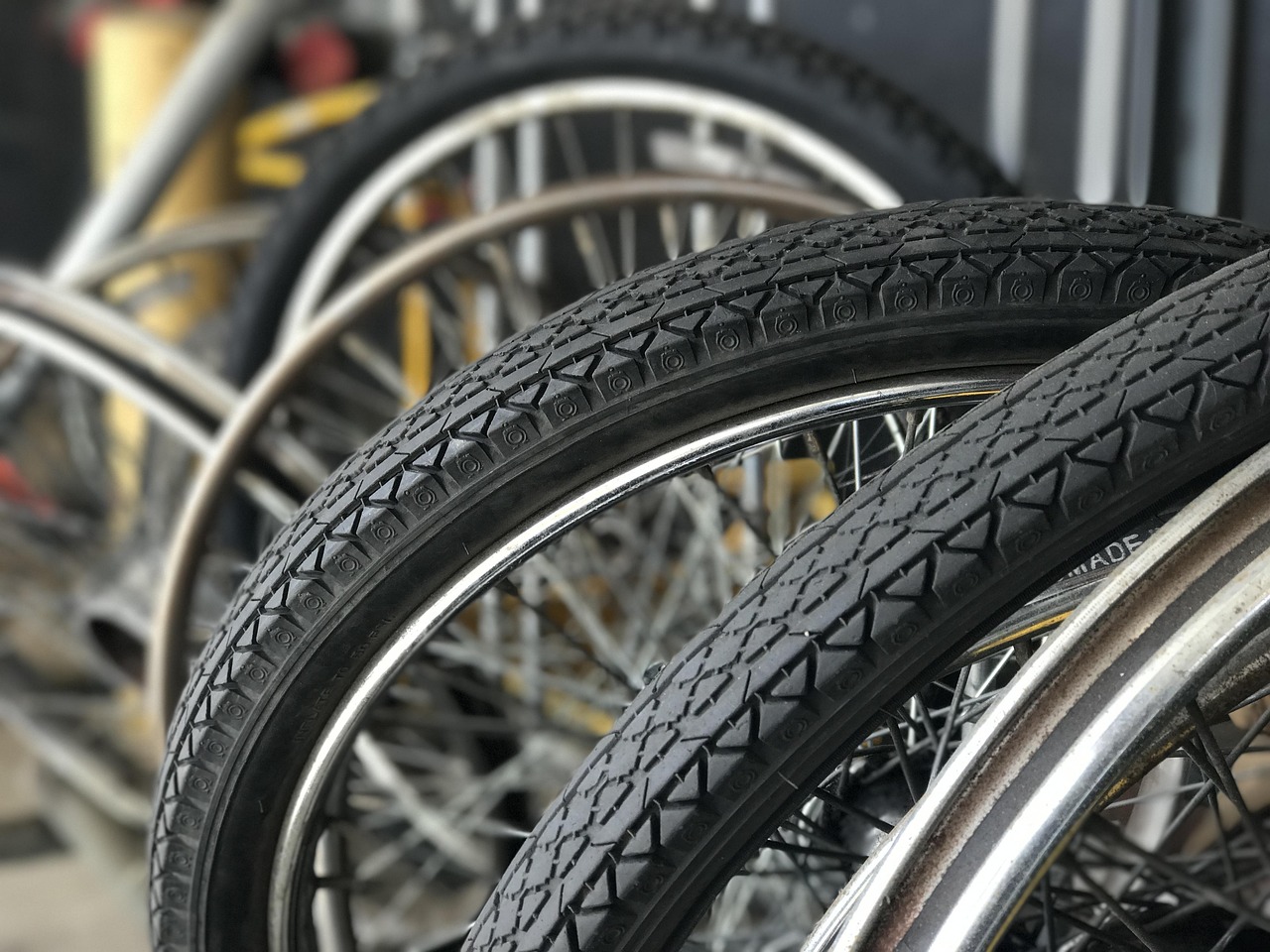
The Schwalbe Marathon Plus tyre is as hard as nails, has a decent tread that’s good on wet roads, but is still slick enough to speed along when dry. As a tourer, I really like the reflective strip around the outside of the rim – if you ever cycle in the dark with these tyres, they can be seen a mile off in headlights (great for tunnels).
The slime inner tubes are in-theory self-repairing, a bit the goo that you put in a tubeless tyre setup. I don’t know how well they work, but as above, I’ve never had a puncture on them so I’m not going to change!
Lining the outer tyre with a cut inner tube just adds a bit more rubber that the tip of a thorn needs to work its way through before it causes havoc. I also wonder (without any actual evidence) whether it helps reduce the risk of pinch flats.
I like to run the tyres fairly hard when touring, hence pumping to 80-90psi, which has the advantage of reducing risk of pinch flats. If they are softer than this you can also sometimes feel the tyre deforming as you corner, which isn’t all that pleasant.
Weight
The obvious downside is that this setup ends up being quite heavy, especially when mounted on a good strong touring wheel. But let’s face it, you’re not looking for rapid acceleration when touring, and I would far rather remain puncture-free than lose a few dozen grams.
What about going tubeless?
Personally I’ve never dared to run tubeless tyres when touring, although I use them on my road bike. My reasoning:
- My experience is that tubeless is great, but occasionally goes spectacularly wrong in a way that I’m not prepared to deal with when I’m on my own in the middle of Europe.
- Therefore I’d want to take one or two inner tubes with me as a backup anyway (to put in the tubeless outer if I couldn’t get it to seal), so what’s the point…
- I’d probably also want to take some tube sealant with me.
- I’d worry about how I’d reinflate a tubeless tyre from scratch, as the little portable pump I carry won’t get enough air in initially to make the seal. CO2 cylinders are an option, but you can’t fly with them.
- I’m not even sure whether the really strong rims I like to use for touring are available as tubeless.
Replacing tyres
If I’m going on a big touring trip I tend to replace the Schwalbe Marathon Plus outers before I go, regardless of how much wear is on them. However, I don’t doubt that they’ve got a few thousand miles in them and this is probably unnecessary.
Tools and spares
Here’s a list of the tyre-related tools and spares I take with me on a standard cross-Europe trip:
- Spare outer tyre (I usually pack an old one, folded and taped up). Will keep you on the road if you get a gash in one of your tyres.
- 2 or 3 spare inner tubes, depending on where I’m going.
- Simple puncture repair kit. Handy to have, as I’ve also used this to repair my Thermarest sleeping mat a couple of times.
- 2 plastic tyre levers.
- Small hand pump. I strongly prefer to have a handpump with a built-in gauge, as I know I’ll never get to the required pressure without it!
- I might consider taking a couple of CO2 cylinders and an inflator instead, but remember you can’t fly with these.
- I also carry a tiny little Presta-Schrader adaptor so that, if travelling in remote Eastern Europe, I can always use a filling-station air compressor to reinflate my Presta tyres.
You might consider all of this to be overkill, but I kid you not, there has been the odd occasion when I’ve needed most, if not all of it and wished I had more inner tubes with me (Greece – I’m looking at you). If you’re touring in France then you can definitely cut it down, but for remote Eastern Europe, who knows what can happen.