If you have done much cycle touring in Europe, you’re bound to have come across Eurovelo, the organisation that manages the network of long-distance cycle routes that cross the continent.
At the time of writing, there are 19 different Eurovelo routes that span Europe from north-south, east to west and follow iconic stretches of coastline and major rivers. Each route is carefully designed to take in major cities and pass by significant historical and cultural landmarks. Anyone planning a major European cycling tour could therefore do a lot worse than to pick a Eurovelo route and spend a lovely month or two following it.
A good place to start your Eurovelo route planning is on their website, here: www.eurovelo.com
However, a word of caution first. My experience with Eurovelo over the years is a mixed bag, for reasons that I’ll explain shortly. My gripes about the routes are not intended to put you off using them, but should hopefully equip you to plan with your eyes open. So here goes, my five complaints are:
Gripe 1: Poor route marking
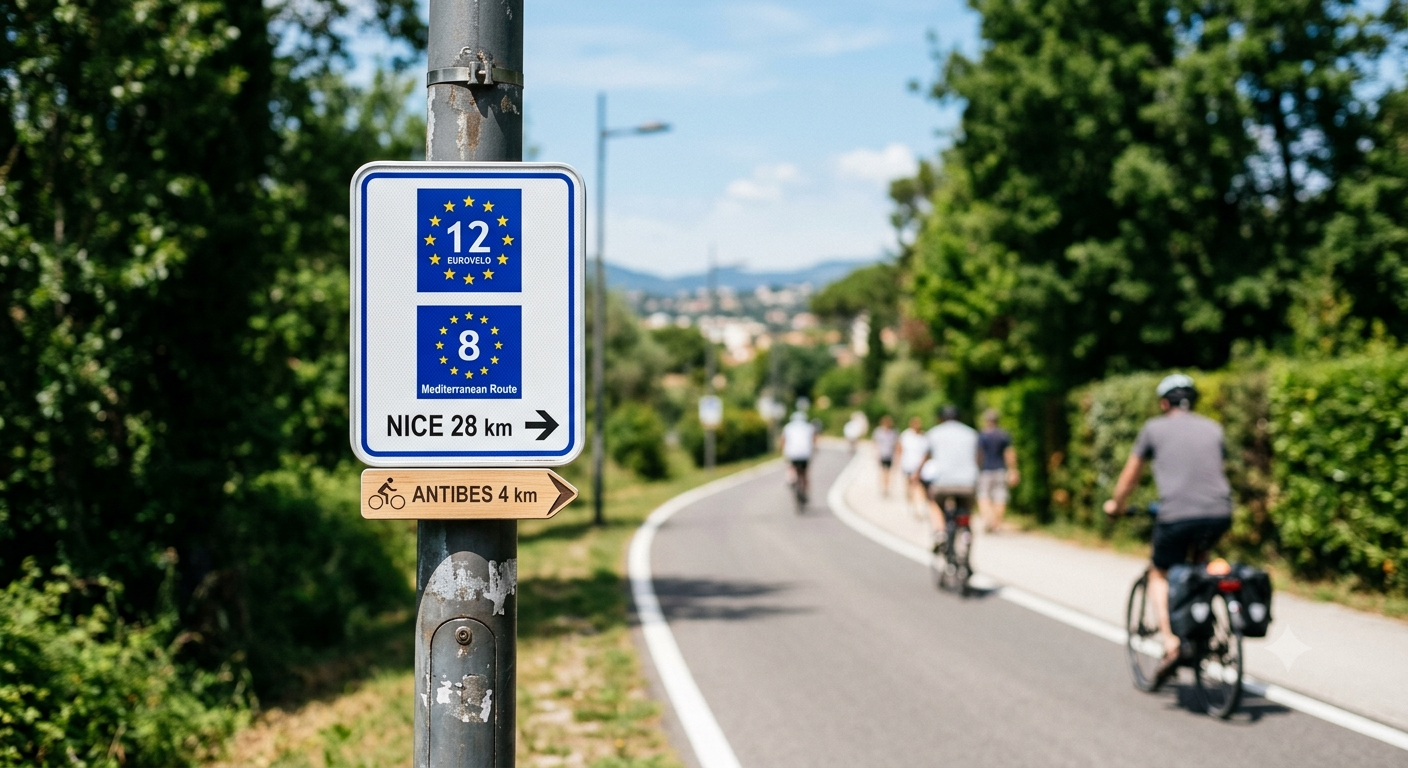
First, the route marking is very variable and can be quite poor. Many of the markers are small plastic squares that are nailed to a telegraph pole or fence post. They’re very easy to miss. And if you do miss one of these markers, then you end up spending the next couple of kilometres getting lost, wondering where you went wrong and retracing your ride to get back on the correct route. Once this has happened a couple of times in a day (and it happens regularly to me) you can waste quite a lot of time and feel your blood pressure rising.
Gripe 2: Over-complicated routes
Second, this the routes can be very complicated. They are designed for cyclists of all ages, so (very sensibly) favour tracks and minor roads, but getting between two towns while avoiding main roads often requires some ingeniously complicated route-finding with a lot of turns. Sometimes you’ll find yourself taking a long diversion when there is an easily-cyclable main road heading in exactly the right direction. And as above, the signposting for these many turns may not be great!
Gripe 3: Terrible mapping
But surely this easily is solved by having a map? My third gripe is that I’ve never found good quality Eurovelo mapping. The Eurovelo app was hopeless last time I tried it (though in fairness this was a few years ago and maybe they’ve ironed out the issues by now), and maybe I’m missing something, but I haven’t ever found a good way to follow the routes using my usual mapping tools. This therefore means you rely on the signposting on the ground… and I refer you to gripe no. 1.
Gripe 4: Bad surfaces
My fourth gripe is that sometimes the tracks it sends you on are very poor quality – a lot of gravel and some deeply rutted farm tracks. A couple of these have been so poor that I’ve had to get off and push rather than risk damaging my bike or getting a puncture. Admittedly, I usually tour on narrow road-bike wheels, but when I’m on a long ride I don’t want anything to risk the integrity of my precious wheels.
Gripe 5: Lack of consistency
My last gripe is the lack of consistency. While Eurovelo design and manage the routes, the implementation of them is by each individual country, and therefore can vary massively by nationality. I recall getting excited by endless miles of beautifully smooth tarmac Eurovelo cycle route alongside a main road in Hungary, only for it to turn into a poorly signposted and gravelled wheel-eater of a track the moment I crossed the border into Serbia.
Even within an individual country, some stretches of a route may be beautifully signposted and ready for cyclists, whereas others are just… wholly absent, presumably waiting for some local bureaucrat to pull their finger out. While these unimplemented stretches are usually highlighted on Eurovelo’s low-resolution mapping, this all adds to the sense that you can’t ever rely on Eurovelo to reliably get you to your destination.
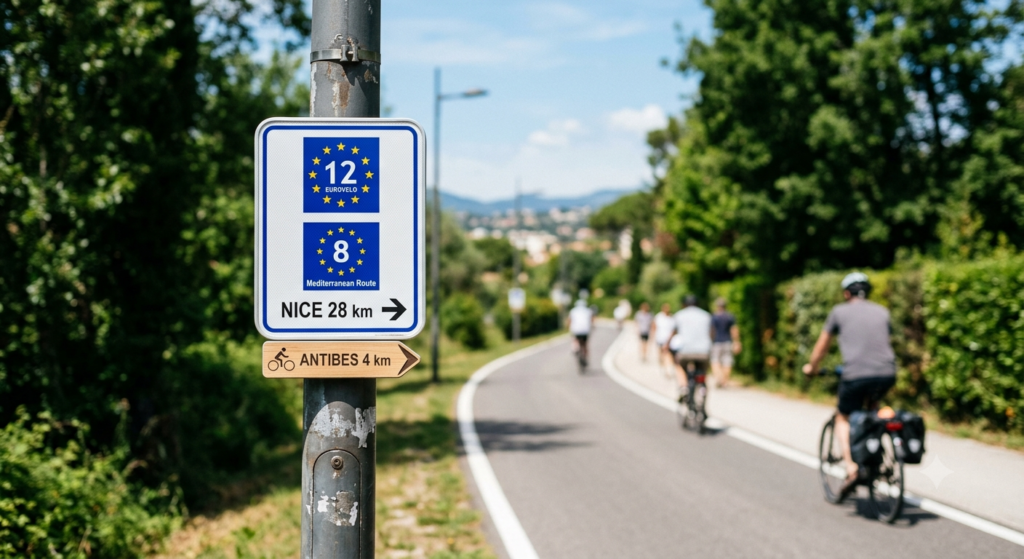
Complaining about Eurovelo always makes me feel a bit sad because in principle it is an amazing idea, albeit one that suffers a bit in its implementation. However, I do wish them the best of luck in ironing out the issues I’ve described.
At its best, Eurovelo can take you to gorgeous quiet backcountry that you’d never have dreamed of visiting otherwise. I’ve cycled through backwater rural eastern European villages where the creation of a new Eurovelo route has been transformative for the local economy, with enterprising villagers setting up bike-friendly hostels and drinks-stops sustained exclusively by the Eurovelo trade.
In countries like Holland and Germany, Eurovelo is at its very best, overlaying long-distance trails on the existing superb cycling infrastructure. Similarly some of the coastal routes can be excellent, like Eurovelo 1, the Atlantic coast route, with its metalled cycle paths carrying you for miles along beautiful coastline.
However, I’ve been burned too many times by Eurovelo, and now never rely on them. I might use the routes as a rough template when planning my ride, and if I happen to find myself on a signposted route then I’ll happily follow it until the first missing route marker inevitably makes me lose my way. Then, slightly tinged with regret at an opportunity missed, I’ll go back to finding my own way across the continent.