Travelling there and back
Spain is served by the usual range of low-cost airlines, all of whom will carry your bike for a fee.
There are also three ferry routes into Spain from the UK – you can sail from Portsmouth to either Bilbao or Santander, or from Plymouth to Santander. They’re long crossings (20 hours plus!) but make an excellent way to start or finish a touring holiday.
Cycling on Spanish roads
In general, the road system is pretty good for cyclists, but with a few caveats.
While there are some excellent cycle-paths in the major cities (Seville is superb) and around the coastal strip, don’t expect too many of them in inland or rural regions. The exception to this is the ‘Vias Verdes’, of which see more below.
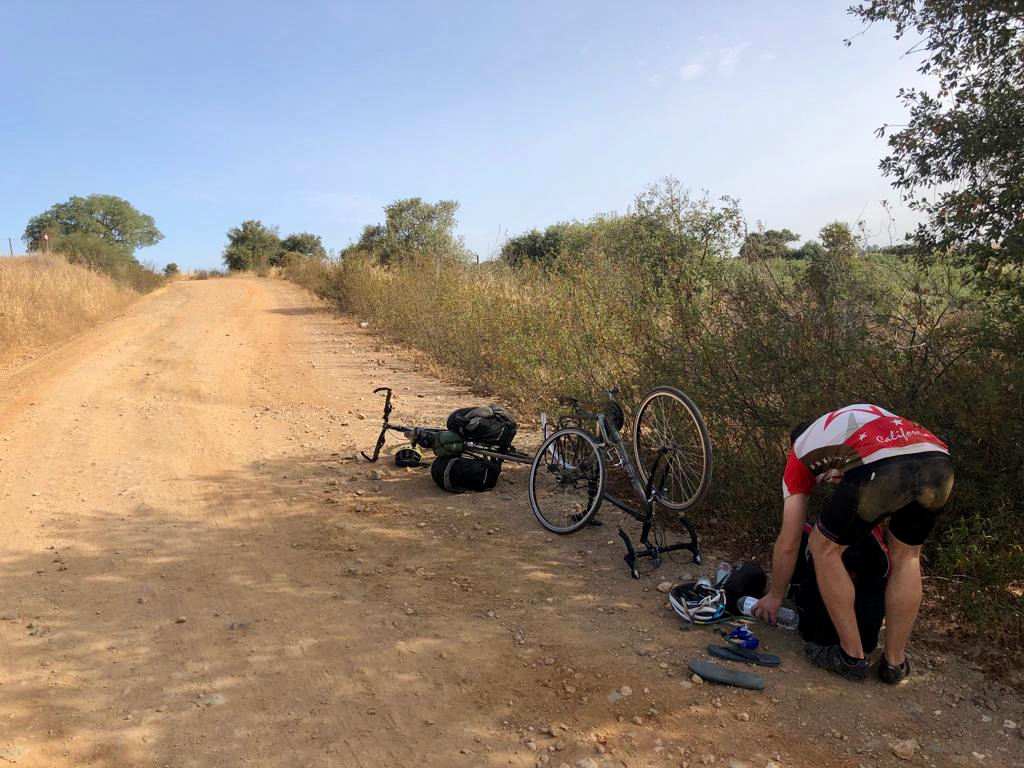
Spain has a lot of unsurfaced minor public roads that are murder for touring on, with a high risk of punctures. The more remote you are, the more likely the tarmac is to run out! This issue is compounded by the fact that I have not found a mapping app that reliably avoids non-metalled roads (Google Maps and Bikemap are both guilty of sending me on unsurfaced tracks). I spent a lot of time using Google Map’s aerial views while route planning, to check whether my route was surfaced or not.
The main single-carriageway roads in Spain (the ‘N’ roads, not motorways/dual carriageways) are variable about whether they allow cycling or not. In general, cycling is allowed on N-roads. However, some of them have strict ‘no cycling’ signs, but generally with no alternative routing for bikes. I found this was especially the case when travelling down through the middle of the country. Again, I haven’t found mapping apps to be reliable on this when routing you. My solution was to use Strava’s ‘heat mapping’ function when doing my daily route planning to see whether other bikes had used a given road – if they had, I assumed it was fair game!
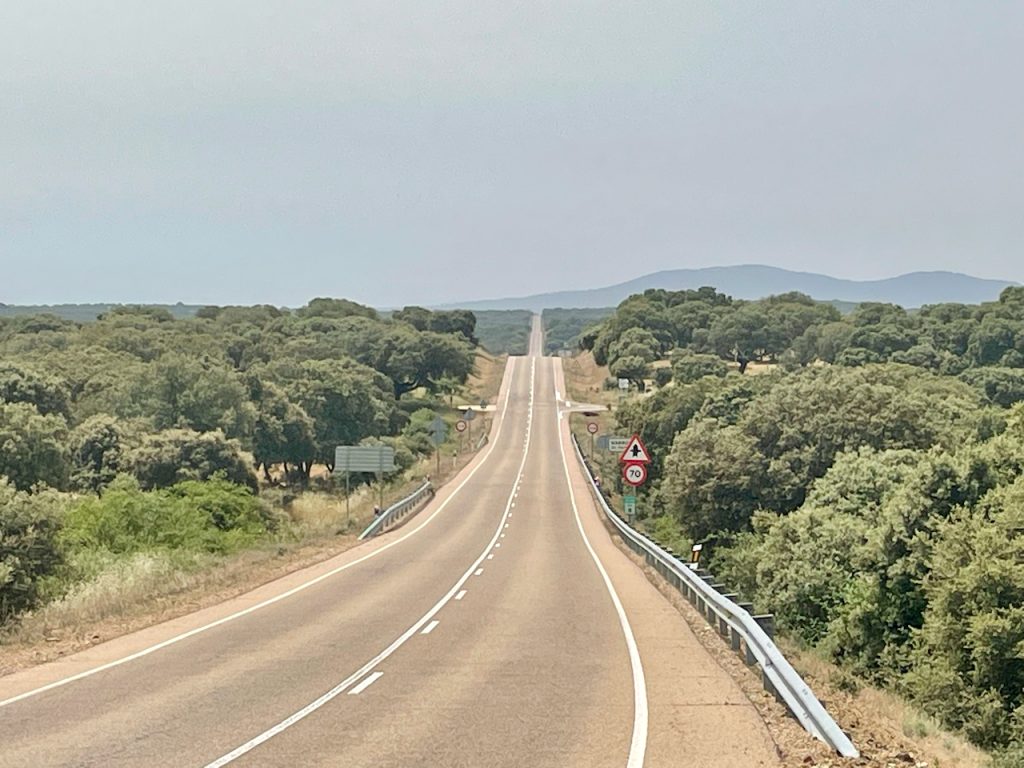
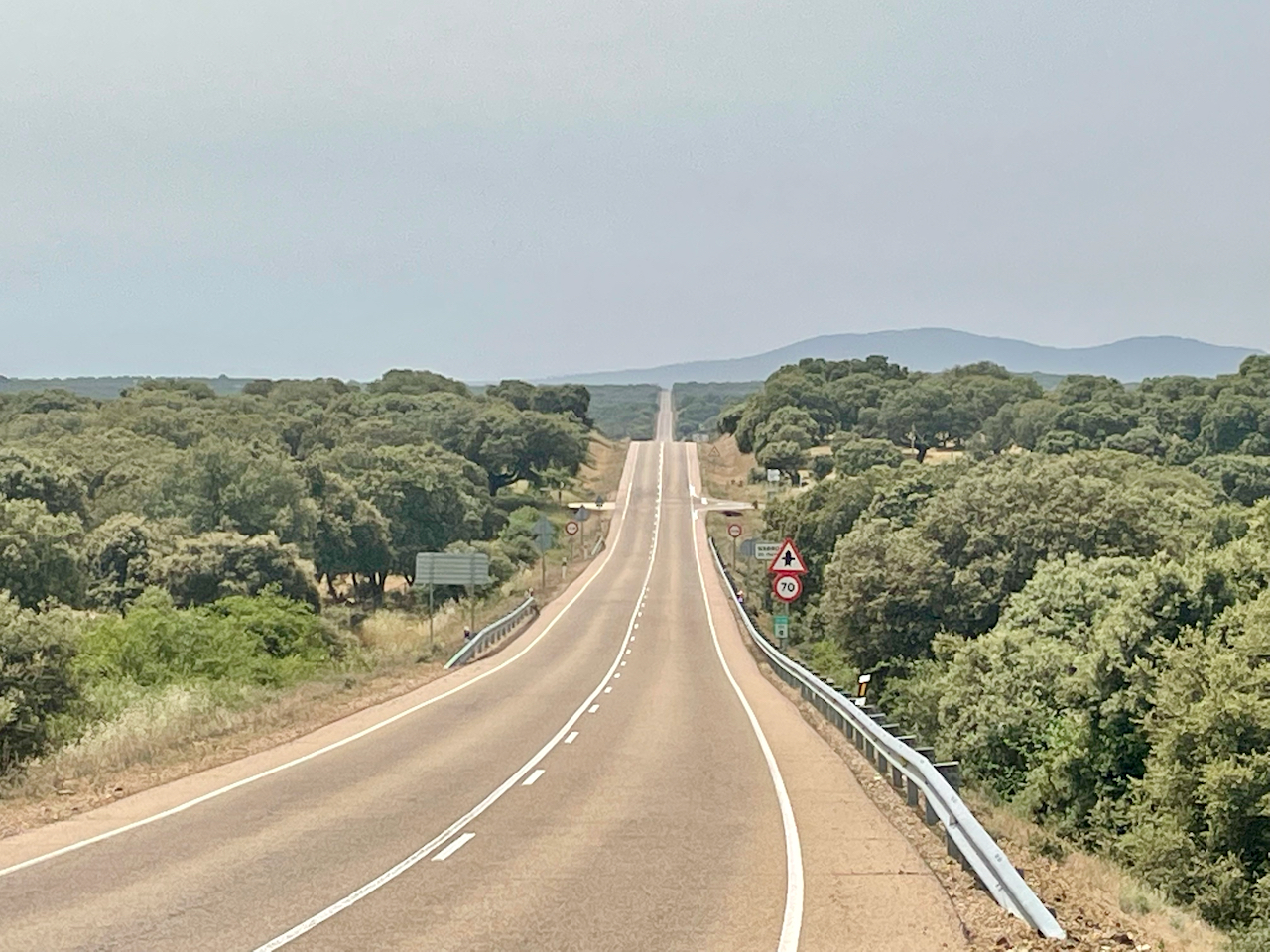
If travelling across the interior, you’d better get used to extremely long, dead-straight roads with zero shade and little in the way of services.
Most main roads have got good roomy hard shoulders, which offer some respite from the traffic even if it’s busy.
As a general rule, I find Spanish drivers to be pretty kind and tolerant to cyclists.
The Spanish ‘Vias Verdes’
Spain has done a good job of converting stretches of old, obsolete railway line to be used as cycle paths – these are called the ‘Vias Verdes’ or green ways. They can be found all over the country and make for a great day-ride; however, I found them of limited utility for cycle touring as most stretches are relatively short (there are no Vias Verdes that cross the country, for instance) and they are in variable states of repair, with some too gravelly and rutted to make for happy touring. While enterprising locals have opened drinks stalls on some of the more popular ones, they can be limited in services and sometimes bypass towns and villages altogether. On the other hand, they miss out all of the big hills and provide some nice cool tunnels!
My advice is to enjoy it if your route happens to drop you on one for a stretch, but don’t rely on them to get you very far on a long trip.
There’s some useful info (and a map of them) on the Cycling Spain website: https://www.cyclingspain.com/inspiration/cycling-the-spanish-vias-verdes/
Spanish rules of the road
Spain has a few specific rules for cyclists, though nothing particularly onerous for a tourer:
- Helmets are mandatory outside towns (unless climbing steeply or in extreme heat), unless you’re under-sixteen in which case they’re mandatory everywhere.
- Reflective clothing is mandatory at night and in tunnels.
- Lights are mandatory at night or in tunnels.
- Riding two abreast is legal but only where safe (i.e. on a wide hard shoulder)
- A bell is mandatory.
Navigating around Spain
As above, the main challenge with navigating on bike in Spain is that none of the apps I’ve tried would reliably send me on the sort of roads I wanted.
Google Maps was a pain (even when set in cycle mode) as it constantly routed me down awful gravel tracks.
Bike Map was equally annoying. It generally avoided gravel tracks (when set on the ‘road’ setting) but it doesn’t recognise any of the ‘N’ roads (the standard main roads) as being cyclable, and therefore goes to any possible length to avoid them. Even if you want to avoid fairly busy main roads for much of the time, they’re often by far the quickest, easiest way to get from A to B, and cutting them out altogether results in some really weird routes. I raised this issue with the Bike Map team, but they said they’d rather keep people safely off the main roads altogether, which is unhelpful when touring!
Strava was also pretty hopeless for route planning, but I did find the ‘heat map’ function useful. This shows how many Strava cyclists have logged routes down any given stretch of road, and therefore helps you avoid stretches which are unsurfaced, or tells you which main roads are cyclable.
Shopping for provisions in Spain
It can be a challenge to find food and drink on Spanish roads, particularly in the rural interior where there are very few garages (and you’ll be lucky to get much more than a bag of crisps and a coke where they exist) and sparsely populated villages without shops.
Couple this with the need for plenty of water when cycling in such a hot climate, and you’ll find you need to carry plenty of spare fluids. I tend to have two 75cl bottles with me and refill them whenever I can. Occasionally, if the route ahead looked particularly empty, I’d stick a 1.5l mineral water bottle on my pannier rack as well.
Don’t forget that pretty much all shops are shut from 2pm-5pm for siesta, though bars in towns may still be open. And be aware that you cannot reliably buy anything on a Sunday. Don’t assume that even a big city supermarket will be open at all, because it probably won’t! Most towns will still have bars open, so drinks are not normally an issue, but make sure you have sufficient food to get you through.
Finding bike shops in Spain
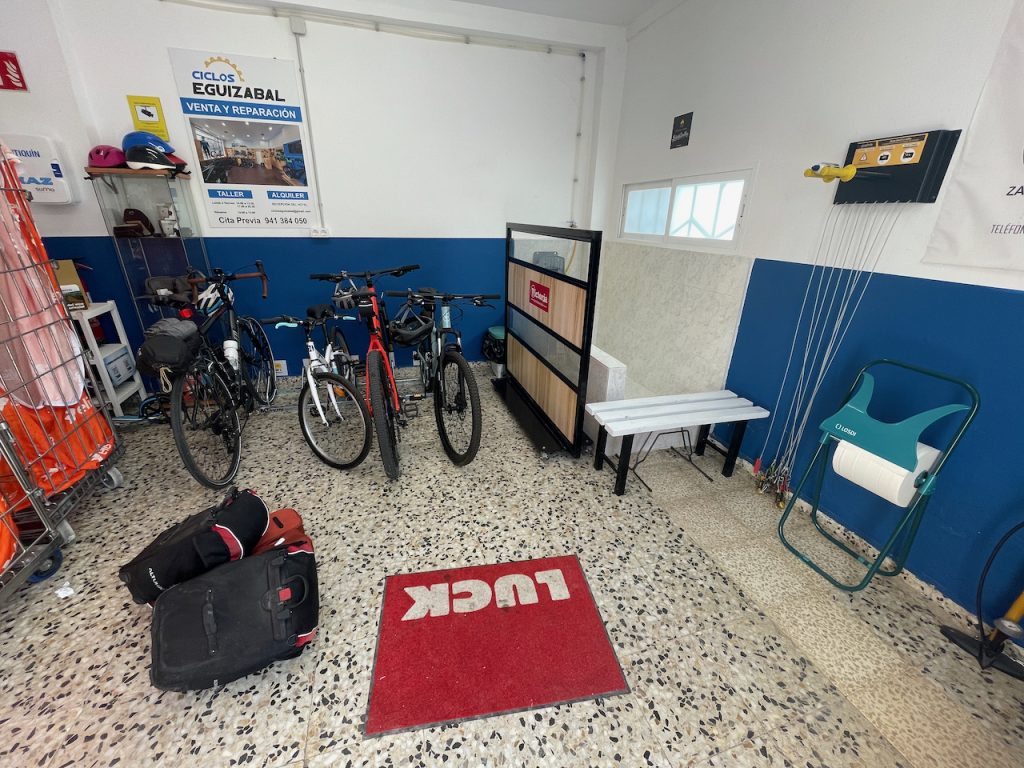
Bike shops are not as common as, say, France. Large towns and cities will reliably have one, but smaller towns may not. Plan ahead with the spares that you carry!
Cost of cycle touring in Spain
Spain is noticeably a lot cheaper than most other western European countries for both food and accommodation.
Finding accommodation in Spain
Wild camping is generally prohibited in Spain, though much of the rural interior is so sparsely populated that I doubt anyone would notice.
There are quite a few campsites, but Spain is a big country and they can be widely spaced, particularly in the rural interior, so you may end up needing to do some long days, or find the occasional hotel. Overall, I find the campsites to be slightly scruffy but very welcoming and great places to spend a night.
There seems to be a trend for northern Europeans to move down to Spain and set up campsites. I’ve stayed at a few run by Dutch families, and one owned by an Austrian. These were universally superb – if you spot one, then stay there, you won’t regret it!
On the odd occasion that there no campsite is available, I’ve never had a problem finding a hotel or a room somewhere. If I need a room for a night in a city, I tend to stop a few miles before I get there and use www.booking.com or similar to book a room, so I can just roll up to the door and jump straight in the shower!
The Spanish climate
Spain can be brutally hot and dry in summer – 40 degrees plus isn’t unusual nowadays in the south and the interior. If you’re accustomed to cycling in the southern Mediterranean climate then it’s doable, but clearly you need to drink and carry plenty of water, limit your distance and listen carefully to your body.
During the high summer you generally won’t see rain in the southern half of the country, though Spain seems to be increasingly prone to the sort of climate-change-induced epic cloudbursts that lead to flash-flooding.
The spring and autumn can offer some beautiful temperatures for cycling, with fairly reliable weather. However, beware that the northern coast and around the Pyrenees is much more prone to rain year-round.
Spanish long-distance cycling routes
There are a couple of Eurovelo routes that cross Spain. Eurovelo 1 (The Atlantic Route) heads up the western edge of Spain and then cuts across the top towards the Pyrenees. While I’m not keen on following Eurovelo routes turn-by-turn (see my page about the pros/cons of Eurovelo), this one gives a good basis for a long-distance route through Spain.
There is also a Eurovelo that heads up the south and east coast. Not to be recommended unless you’re very fond of tourist hotspots and overdeveloped coastline!
No article about long distance routes in Spain would be complete without mentioning the Comino de Santiago, the ancient pilgrimage route that crosses northern Spain from east to west. While this is always packed with walkers, there is plentiful accommodation and regular refreshment along the way.
Spanish cycle touring highlights
I haven’t cycled the whole of Spain – that would take a lifetime – but here are a few thoughts on where to go/not go:
Cycling straight across the interior (in any direction) is surprisingly tedious. Much of central Spain is a high plateau that is sparsely populated with very long, straight roads and little infrastructure. I’ve cycled a roughly straight line from Bilbao to Faro (in Portugal) in the past which goes straight over the plateau. While I enjoyed it, I probably wouldn’t go this way again.
The north/south route that roughly follows the Spain/Portugal border is superb – some of the best touring I’ve ever done. It has plenty of campsites, but it is fairly hilly. Faro is a good place to start or finish as it has plenty of flights from the UK, though I wouldn’t recommend spending too long in the town itself!
Likewise east/west along the northern edge of Spain is lovely, and avoids the plateau. It’s a particularly attractive stretch of coastline, but the area inland is also well worth it. Again, it’s very hilly. The ferries into Santander and Bilbao are a good way to access this stretch.
There’s some lovely cycling around the south coast, around Andalucia and Gibraltar including inland. However, I tend to avoid pretty much all of the remaining eastern coastline up to the French border, as much of it is busy and over-developed.
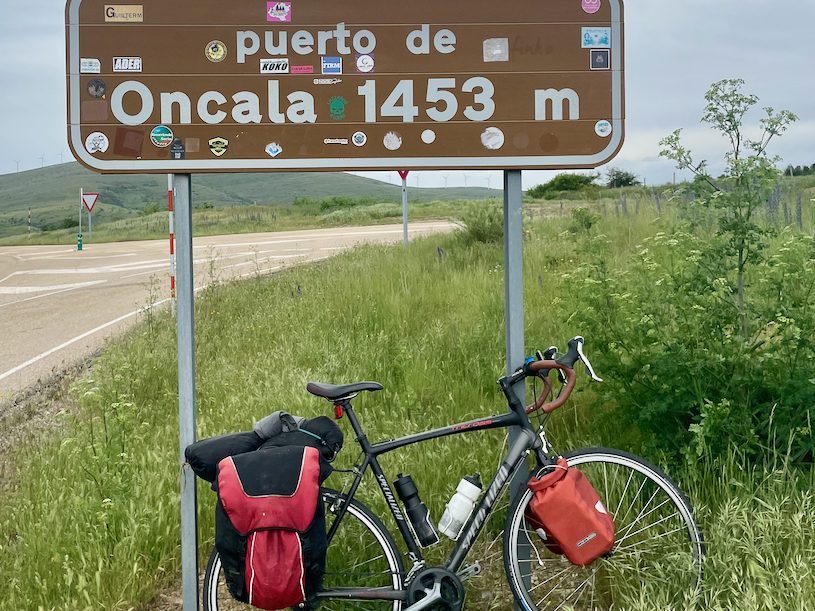
The Spanish Pyrenees are wonderful, but finding east-west cycling routes is a challenge, and there are some big hills to cross.
I know that a few cycle-holiday companies run trips from Bilbao-Valencia and Bilbao-Barcelona. I’ve never done these routes, but folk who have done them have said the start and the finish are great, but there are some less exciting days spent crossing the interior.
Photos from our trips to Spain